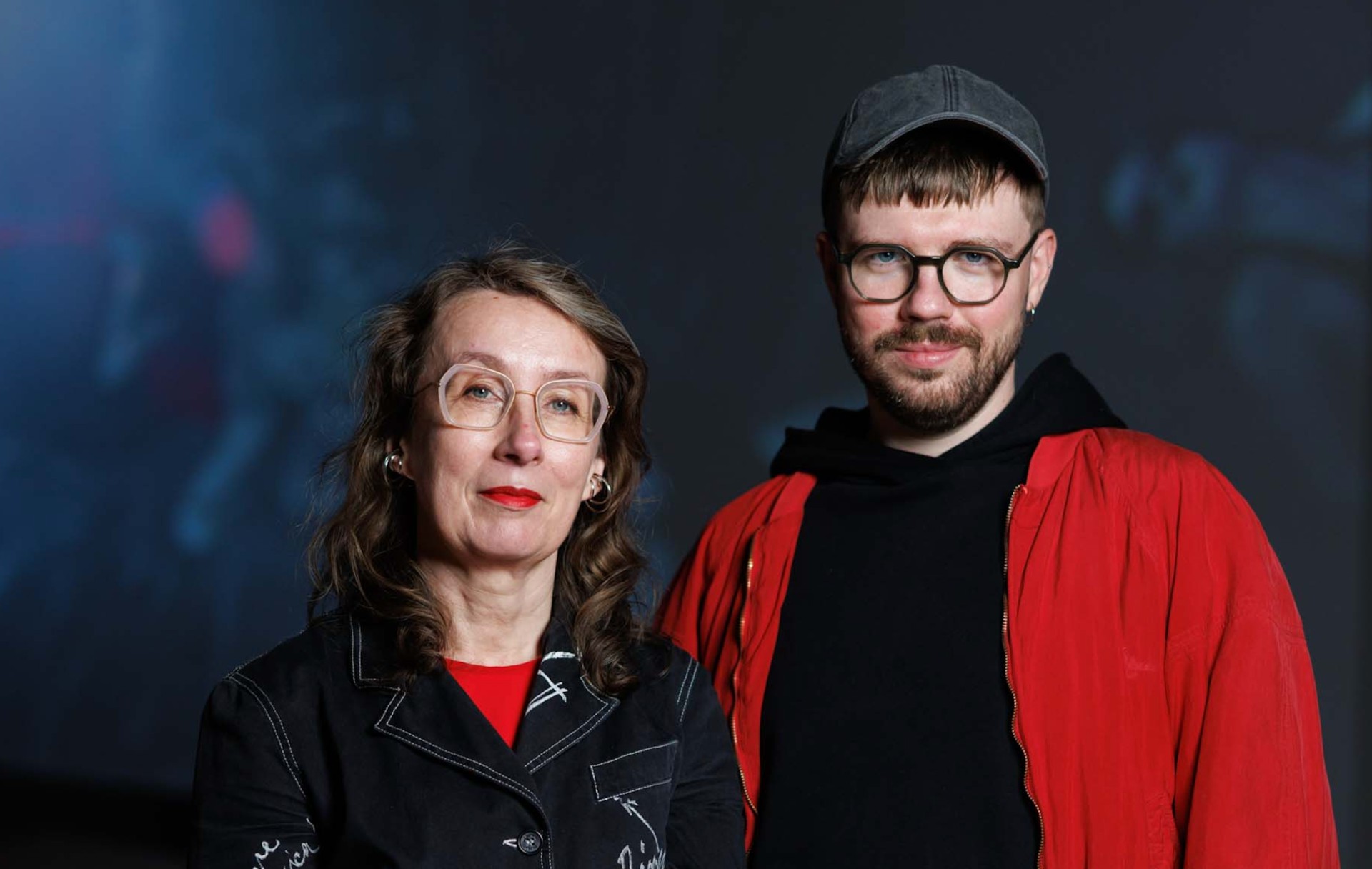
Artists Bogna Burska and Daniel Kotowski in conversation with artist and curator Kolja Glaeser, on the occasion of Liquid Tongues, a project for the Polish Pavilion at the 61st Venice Biennale.
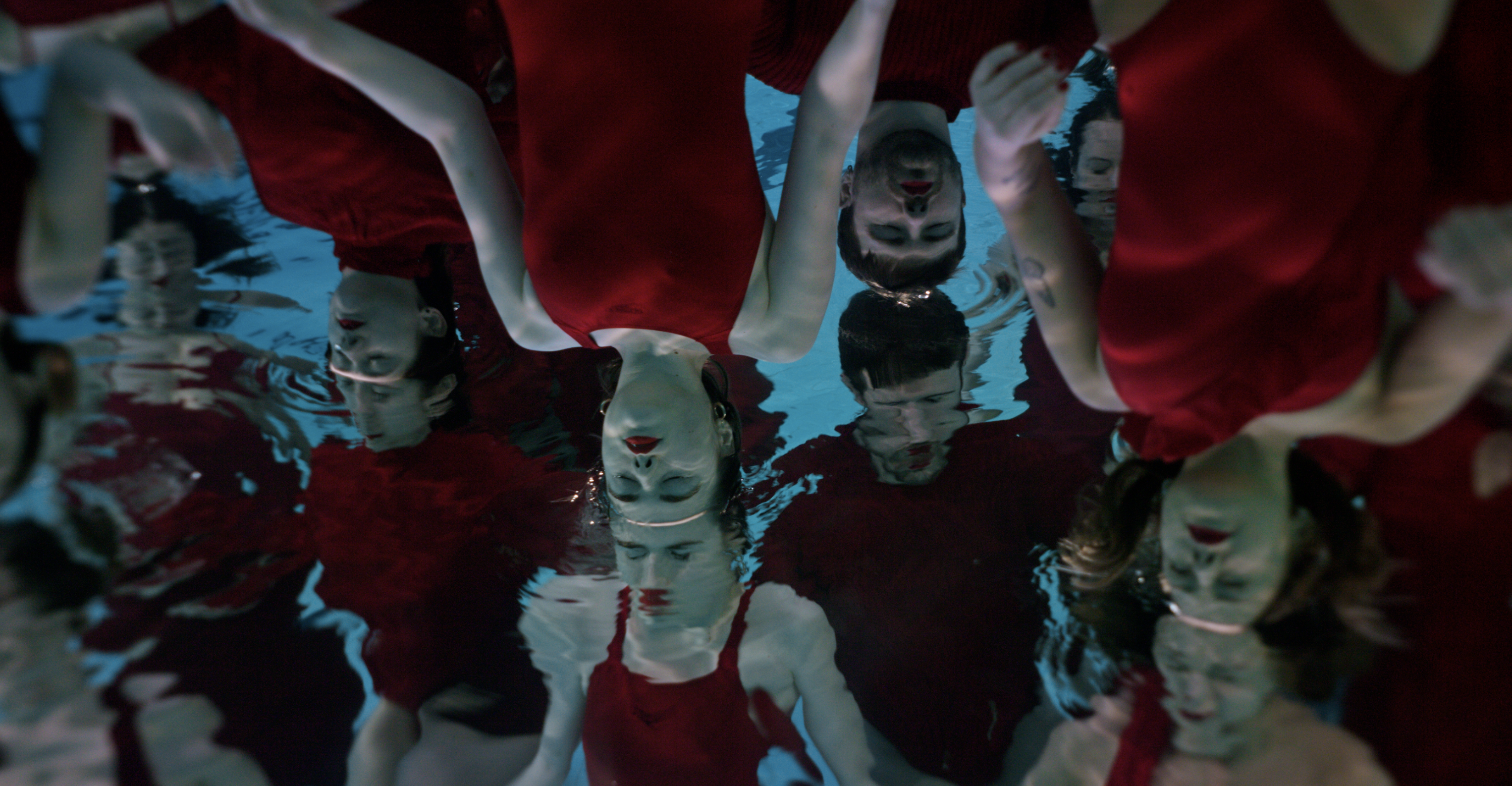
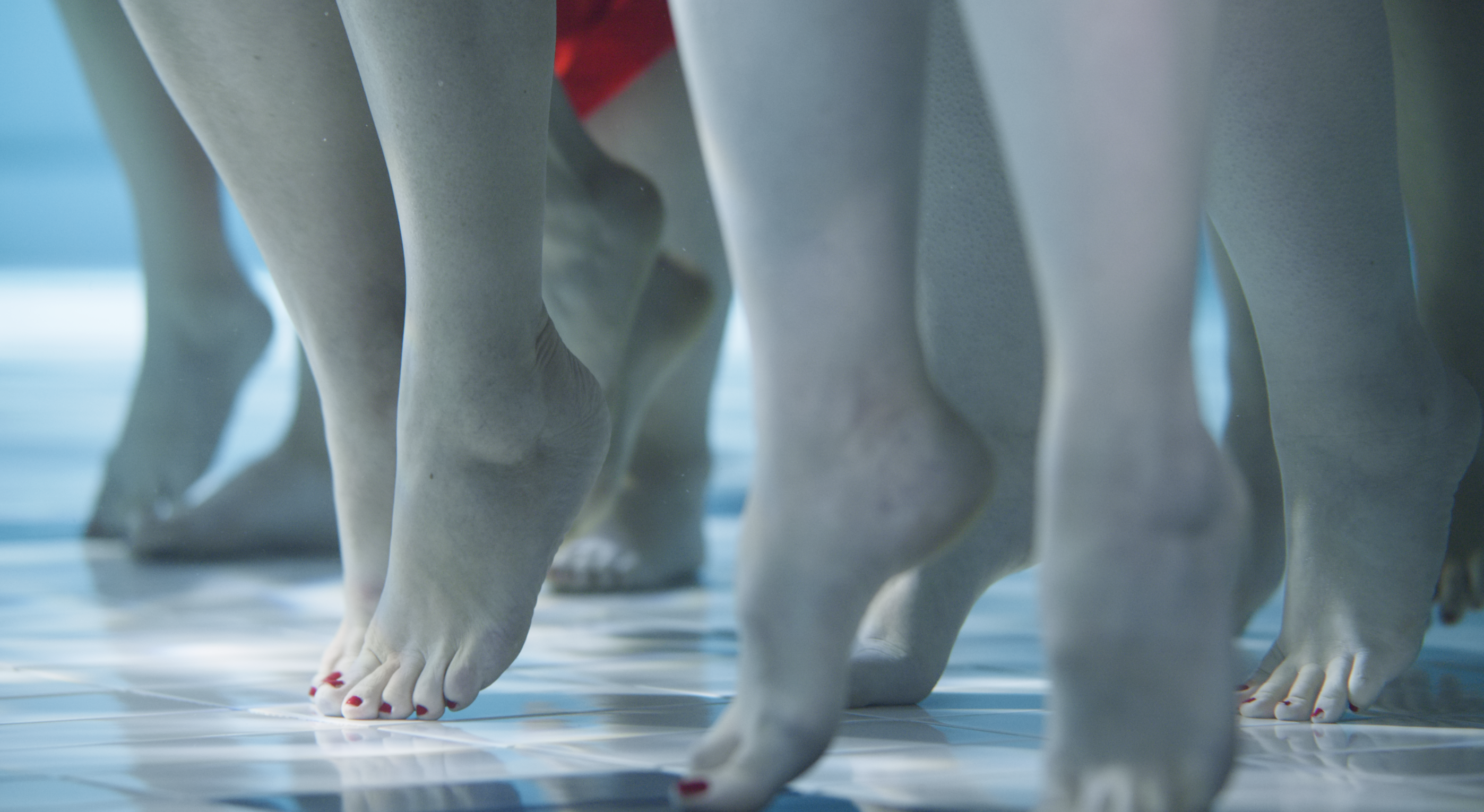
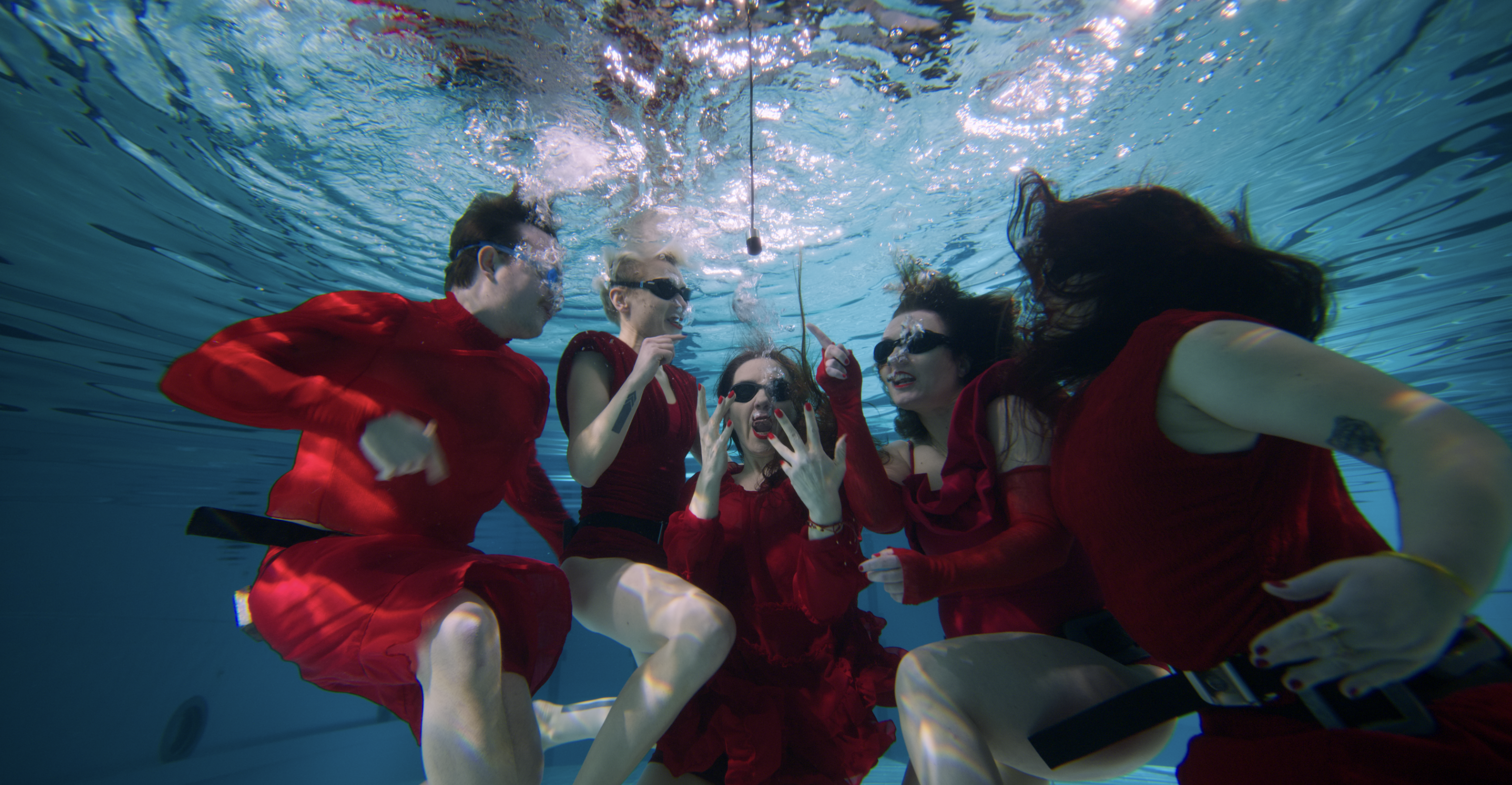
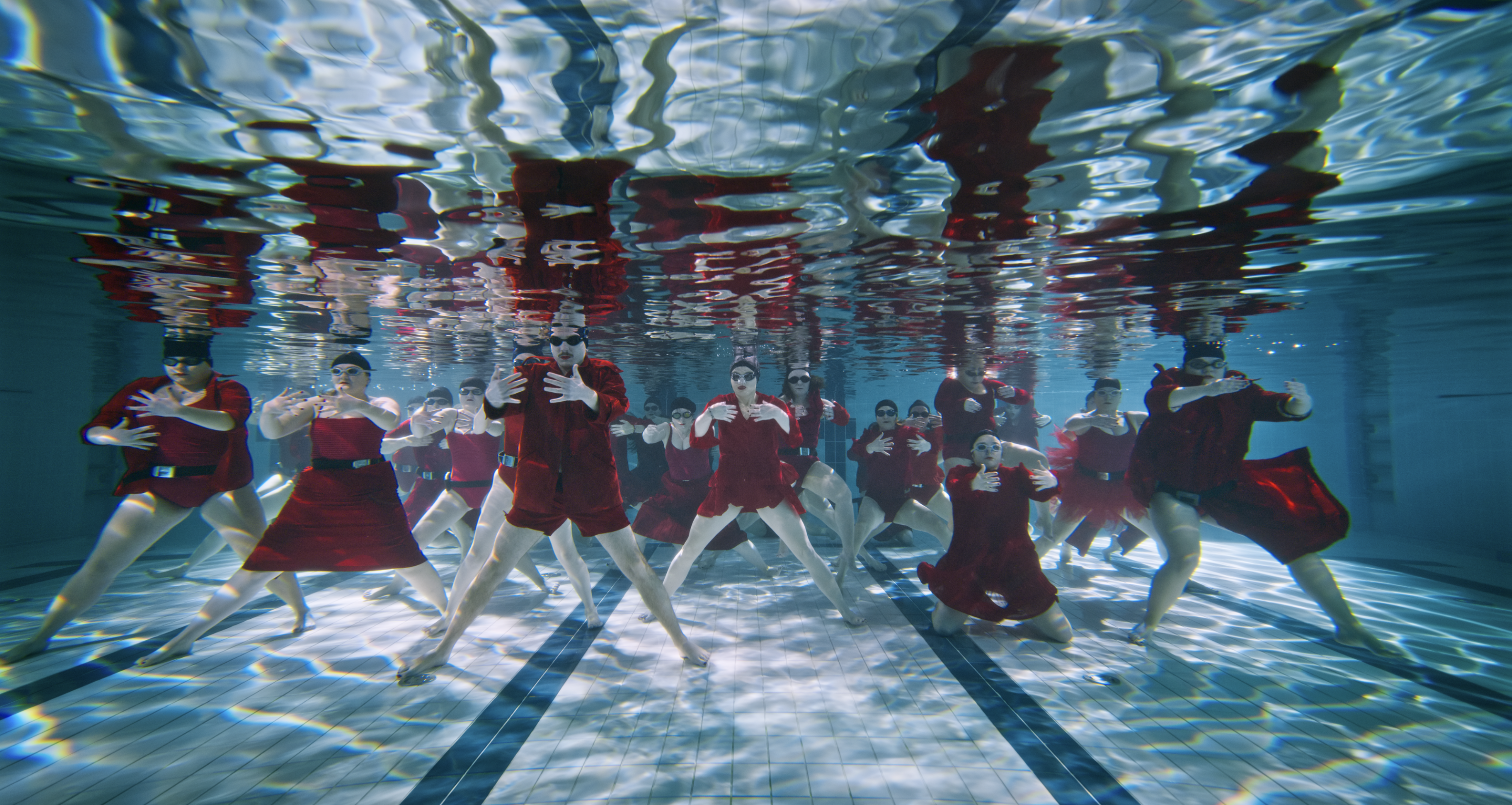
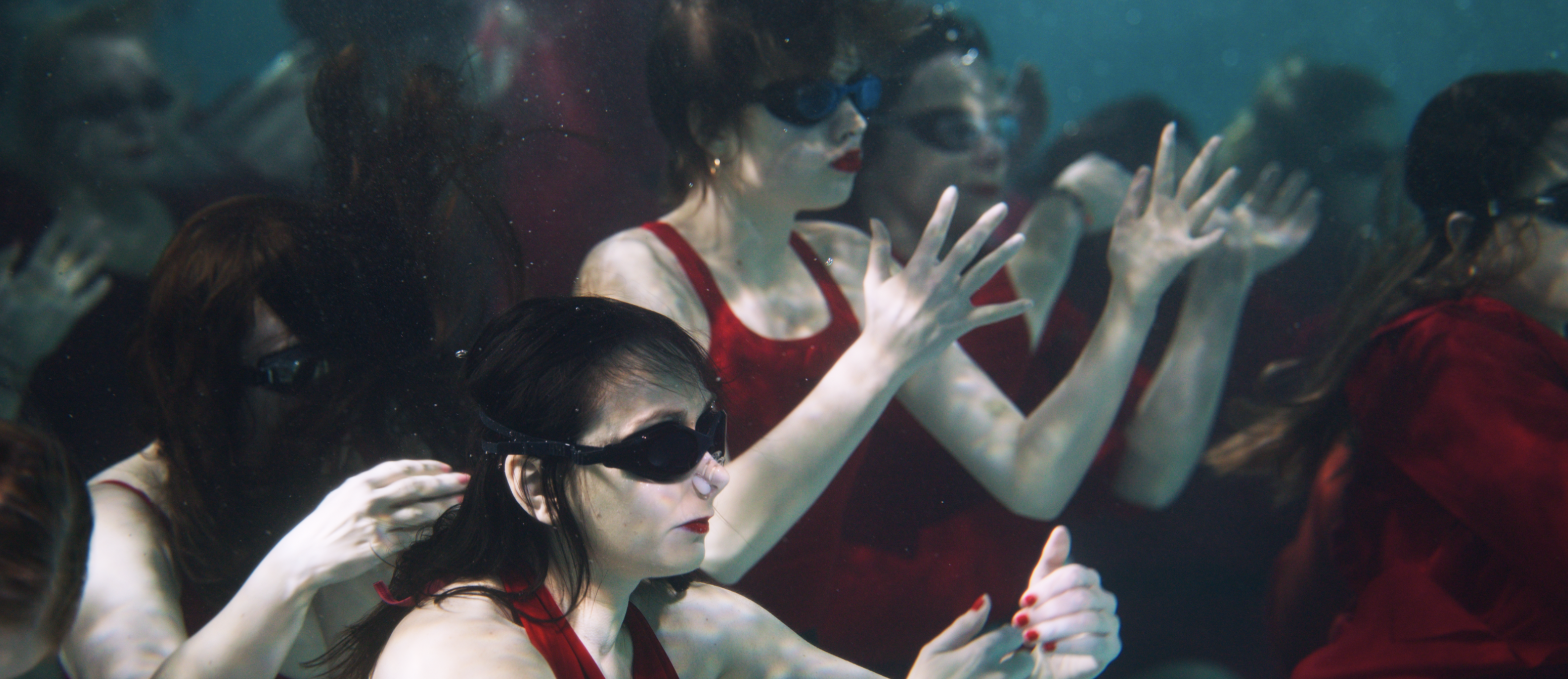
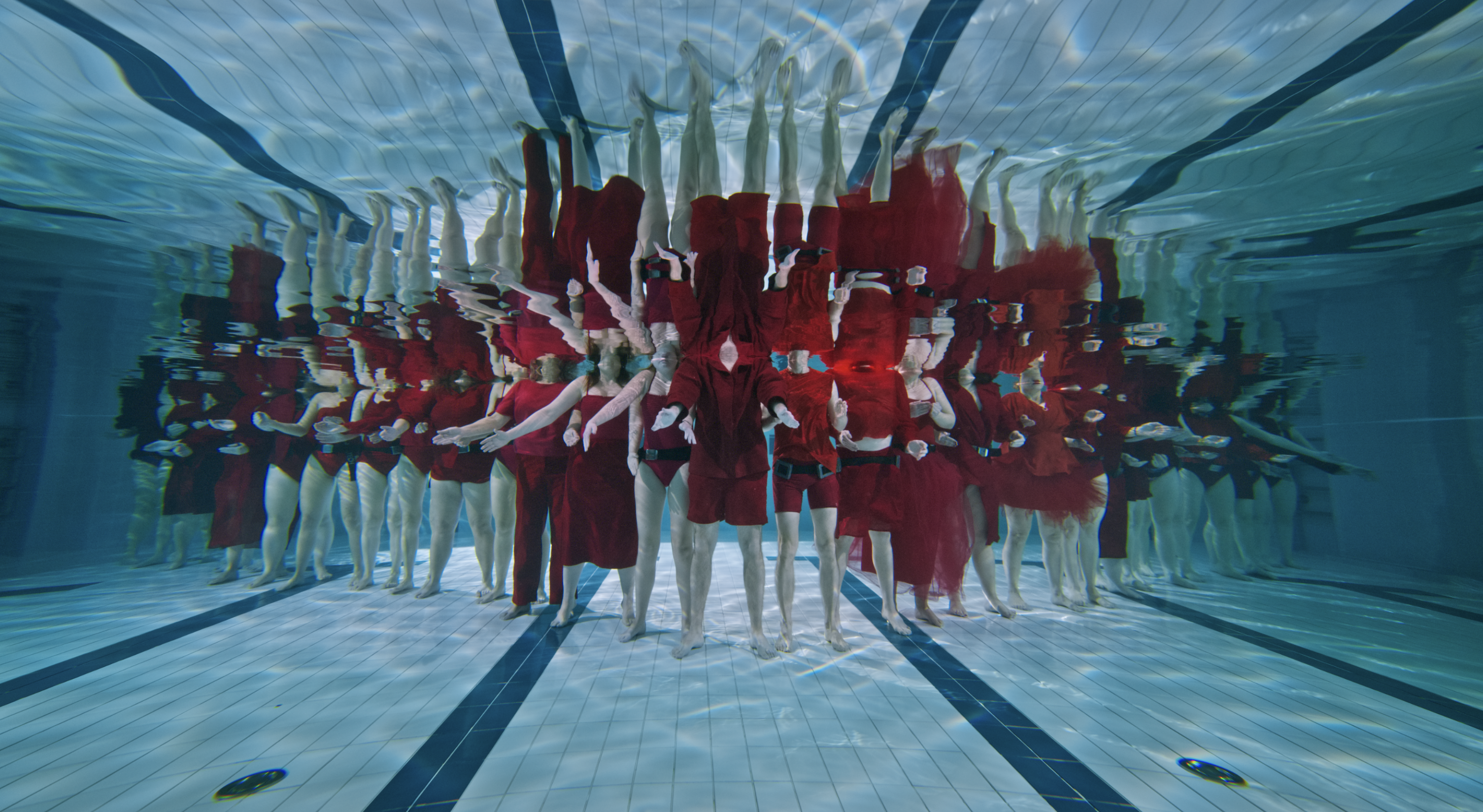
Bogna Burska and Daniel Kotowski's Liquid Tongues at the Polish Pavilion at the 61st International Art Exhibition in Venice reorients our understanding of language. The two-screen video installation, curated by Ewa Chomicka and Jolanta Woszczenko, asks a simple question: what does language look like with the voice removed? Underwater, spoken English collapses into distorted noise; Kotowski's signing continues undisturbed. The work is grounded in the concept of Deaf Gain, a theoretical structure that reframes deafness not as a deficit but as a distinct cultural and perceptual position. It assembles a community of hearing and Deaf performers, the Choir in Motion, to interpret whale communication in both spoken English and International Sign, a contact language belonging to no nation.
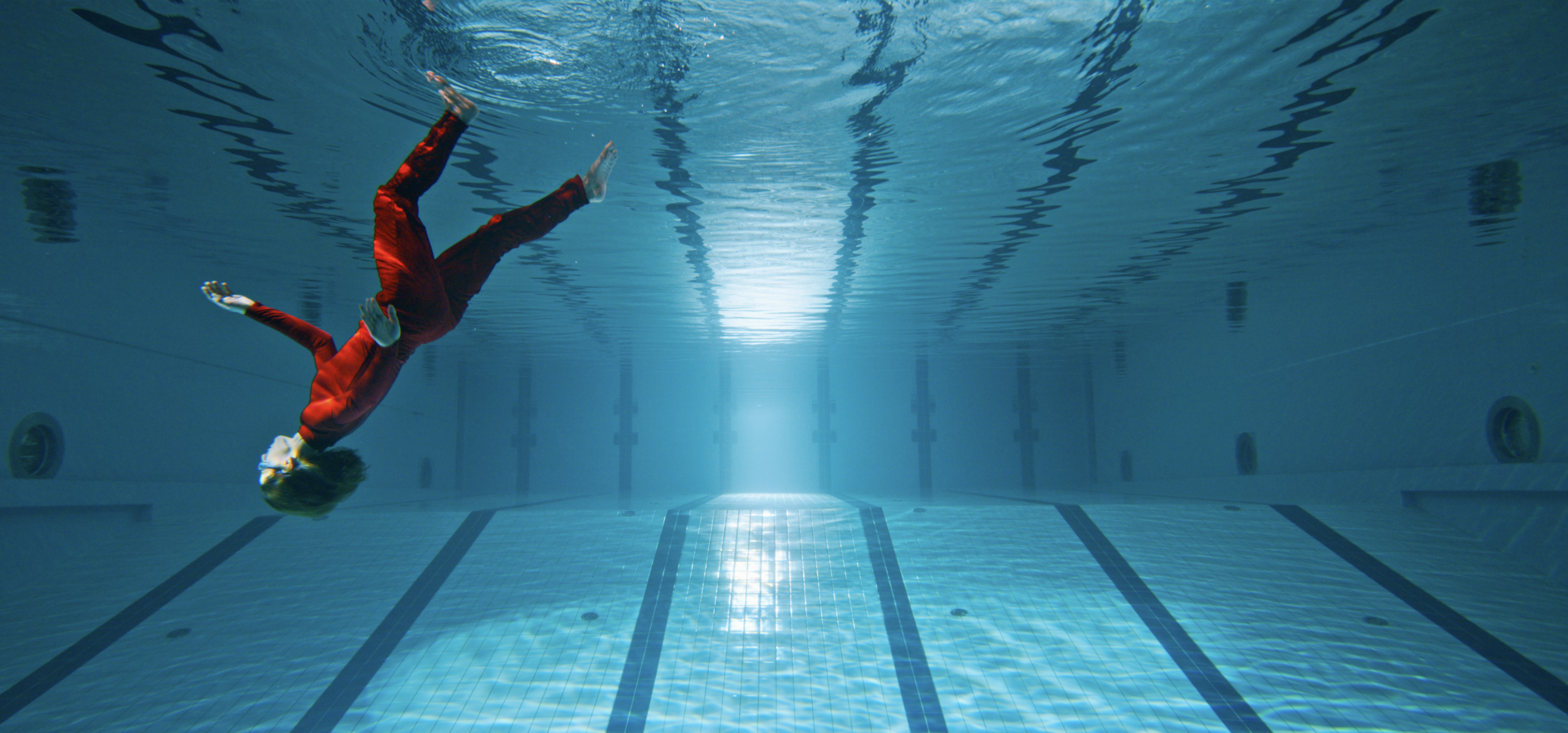
Underwater, the hearing lose their primary instrument entirely, producing only distorted noise, while Kotowski's signing continues without interruption.
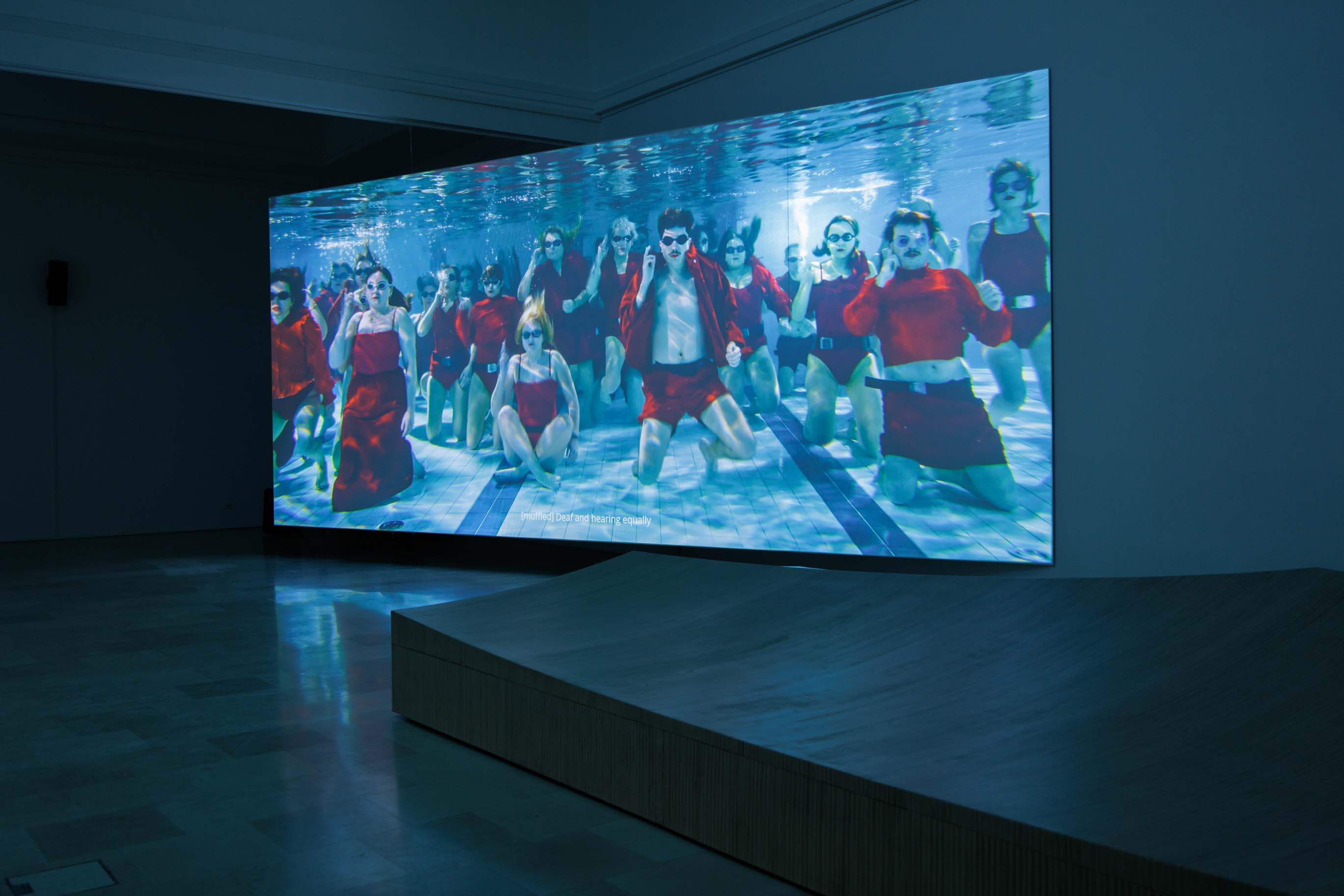
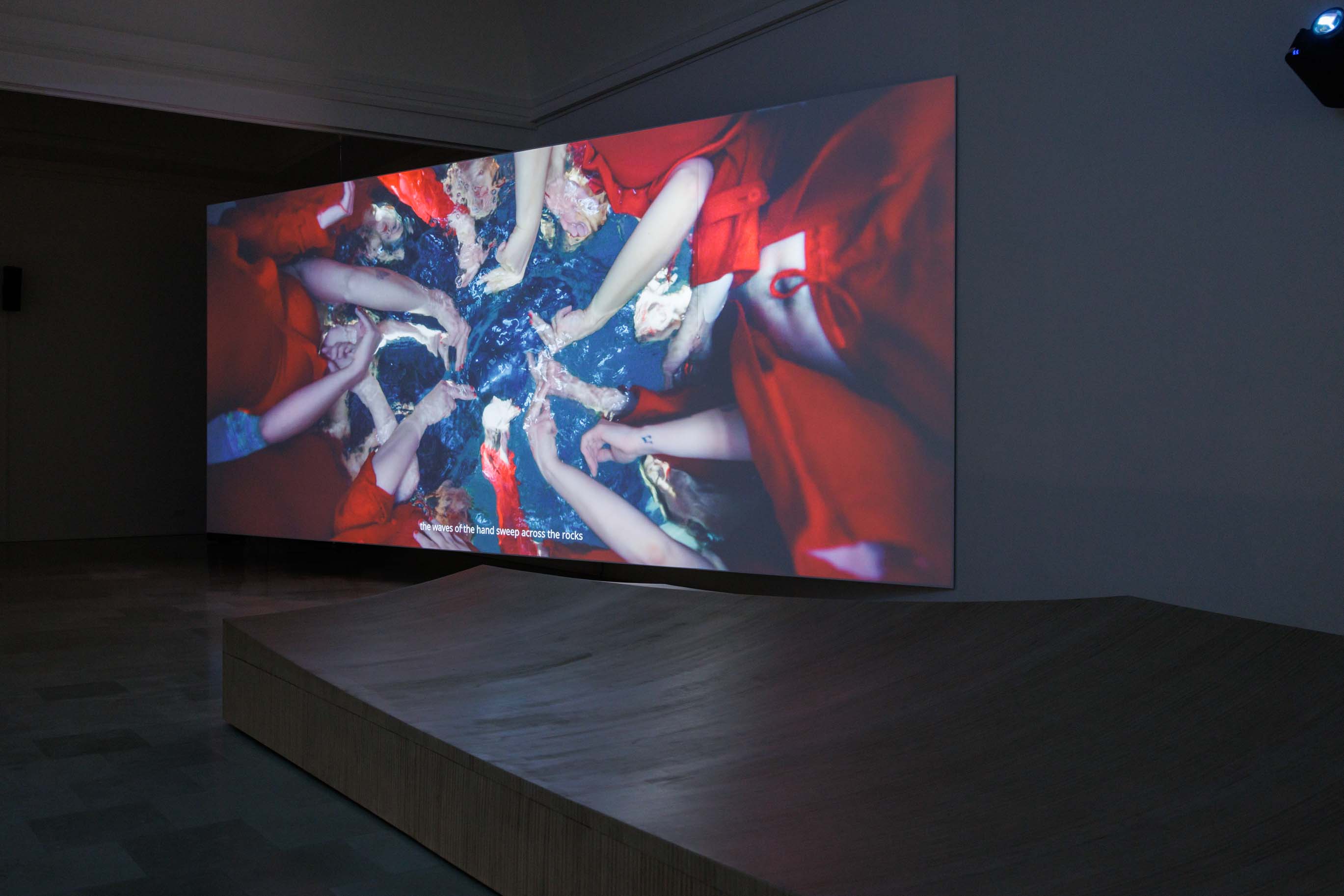
The installation draws on Roger Payne's 1970 recordings of humpback whale song, which helped catalyse the global ban on commercial whaling by making audible, to a general public, the sentience and cultural depth of cetacean life. Burska and Kotowski extend that logic: the whales, it turns out, had been composing, collectively revising, and transmitting their songs for millennia before the first human being filed a patent on language. The pavilion's two screens, one of which hangs overhead so that visitors look up as if from the bottom of a pool, suspend the viewer in a space where Aleksandra Gryka's acoustic waves address the body as much as the ear. What the interview that follows makes clear is how much of this work resists being summarised. Some propositions, it seems, travel better as signs than as sentences.
Interview
Kolja GlaesercuratorThe title Liquid Tongues does a lot of work at once — it evokes fluidity, plurality, the dissolution of fixed form. But it also has a slightly unsettling quality, as if language itself were something unstable, something that might not hold its shape. Was that ambivalence intentional, and how did the title arrive?
Bogna Burska, Daniel Kotowski, Liquid Tongues, 2026, video, Zachęta Archive
Daniel KotowskiartistThinking about the title Liquid Tongues, I see it in relation to experiences of barriers that the world creates as a system. The more of these experiences I have, the more we as Deaf people seek other possibilities of communication, not within a single system, but across multiple parallel forms. Forms that also allow us to communicate with this system. It is a system that serves the majority society and imposes a single dominant mode of communication. This form is not adapted to Deaf people. In this sense, communication and human relations always go beyond one language or one system.
Bogna BurskaartistThe title is a translation from Polish Języki z wody. Thing is, in Polish "Języki" are as well languages and tongues, we have just one word for both. In Polish this title means "languages originating in water" and body organs "tongues made of water" at the same time. In English we had to look for something as close as possible.It started when in 2024 I watched the documentary Fathom, depicting research and fieldwork of two bioacousticians Ellen Garland and Michele Fournet, who study humpback whale communication. I was already in a process of looking for funding to restage my play Rebellion of the Deaf with phonic-signing choir with hearing and Deaf members, together with Ewa Chomicka (curator of Liquid Tongues) who curates Choir in Motion since a very long time. After watching Fathom I was stunned, I watched it again and called Ewa to say that hearing-Deaf choir should interpret whale communication, I mean, should try to fantasize about it. I got the idea that we should join human phonic and sign languages to create a super human language that expresses itself in sound, image and space at the same time to try to imagine communication beyond human.After watching Fathom I started to research whale communication, it is 30–40 million years old and evolved in water. Part of cetaceans also echolocate to understand space and other beings. Album Songs of the Humpback Whale recorded by Roger Payne helped to save whales from extinction and now cetacean communication is being very thoroughly and intensively studied, we know that it is as complex as human language, and also very diverse in its forms. So these are the languages born in water and we need liquid tongues to learn them (in a dreamy but not impossible future) :) I called it Języki z wody.In 2024 I asked Daniel to lead Deaf part of the choir and teach hearing people signing in renewal of Rebellion of the Deaf, we finally staged it in January 2025. I also told him about the whale communication and asked if he could try to create signs for whale calls. He agreed to continue the process with Deaf-hearing Choir in Motion in Liquid Tongues. While learning underwater filming I got the idea for video reversing the usual communication hierarchy by signing and talking underwater, in 2025 we filmed Breathe together with Daniel and Magda Mosiewicz, who later was Liquid Tongues DoP. For Liquid Tongues project worked many people - curators deeply engaged in artistic process Ewa Chomicka and Jola Woszczenko, choreographer Alicja Czyczel, composer Aleksandra Gryka, Choir in Motion, freediver Natalia Wilk, producers Michał Kubiak i Anna Kowalska from Zachęta – National Gallery of Art in Warsaw which is responsible for Polish Pavilion at the Biennale, film producer Mateusz Wajda and crew. It was true group work.Despite fantasizing about super-human language, about translating beyond human and talking to whales, which makes me really happy, thrilled and enthusiastic, thinking about the language as such is for me internally contradictory.In a broader sense of course, we need elasticity-liquidity in communication, we need to grow to be able to realize how complex and rich is the world around us, and how much other human and non human beings can offer if we only pay attention. Undeserved privilege very strongly limits our cognitive capacities and empathy. Daniel always underlines Deaf elasticity in communication. There are so many ways to relate.I was always struggling with the idea that language is very limiting, especially because we give it such a high value. That while transmitting to someone important ideas you can't go beyond it. So it limits our values and perception. I like Burroughs' concept of the language as a virus, or Nick Enfield's who thinks that words by directing attention can act as off-switches for the mind, limiting a broader understanding, framing affects how we understand and reason. We know that we can think beyond language and we communicate in so many ways, not only using the language. Yet, we insist on distinguishing ourselves from the animal kingdom in a big part because of the language. I find the proposition of provincializing language in How Forests Think by Eduardo Kohn very accurate.
Bogna Burska, Daniel Kotowski, Liquid Tongues, 2026, video, Zachęta Archive
Kolja GlaesercuratorHow did that suspicion of language shape the text you actually wrote for the pavilion?
Bogna BurskaartistWe chose poetic form for our text in Liquid Tongues, because poetry leaves the most space between the words, challenges the language structures. It opens and fractures the language.On one hand I was fascinated by the idea that whales communicate as we do, that their forms of communication could be like our languages. But at the same time I'm aware that it's very sad, that we have to realize that whales sing to stop mass killing them. Or that we need to realize that they might have the language to respect them. It is sad that we need to see other forms of life as very similar to us to appreciate them.Or maybe, if whales have their own languages, we need to rethink the concept of it and first of all simply give up anthropocentrism once and for all.To your question, for now language holds its shape (and central place in the human centered world I guess), but we shouldn't be misled by it. Or, we should keep trying to create liquid tongues.
Kolja GlaesercuratorWhat you articulate in the closing passages of your response touches on something that often goes unspoken in discussions of this kind of work: the melancholy embedded in the very gesture of cross-species empathy. That we require resemblance before we grant respect, that whales had to be shown to sing before we stopped killing them at scale, is not a hopeful foundation for interspecies ethics. Kohn's How Forests Think earns its place here precisely because it does not merely critique anthropocentrism but dismantles the epistemological ground it stands on entirely.Which brings us to a question that sits just beneath the surface of what you have described: Kohn's argument is rooted in Amazonian thought and in an Indigenous relational ontology that Western academia has a complicated history of reframing and absorbing into its own discourse. Now that the book has become a reference point for the work, does that history give you pause, and how do you think about the difference between a radical idea finding its rightful place and that same idea being domesticated by the very institutions it set out to challenge?
Bogna Burska, Daniel Kotowski, Liquid Tongues, 2026, video, Zachęta Archive
Daniel KotowskiartistThinking about this reference to the book, I return to the experience of Deaf people. It is very often dehumanised, for example through comparisons to animals, such as saying that we "wave our hands like monkeys." For a long time, I did not understand where this way of thinking came from, until I read Sunaura Taylor's Beasts of Burden: Animal and Disability Liberation.Taylor shows that the way we treat animals is closely connected to how we treat disabled people, because difference often leads to dehumanisation and to being seen as not fully human. If animals are treated only as resources or objects of utility, this logic easily extends to people considered "unproductive" or "useless."In this sense, changing the social perception of Deaf people is inseparable from recognising that our communication is a fully developed, complex language. That is why understanding the specificity of Polish Sign Language remains so important and so necessary today.Taylor also points to a reverse mechanism: attributing agency and sentience to animals can shift how they are perceived entirely. Only then do we begin to see them as beings with their own experience and inner life.
Bogna BurskaartistThe colonial dimension of that question is one I sit with rather than resolve. Can we learn from traditions that suffered colonization from which we, as Europeans and Westerners, potentially benefit? I genuinely don't know, and it is probably not mine to answer alone. But should we learn only from our own tradition, one that has brought so much tragedy upon others? Many of us hope there is another way, without idealizing or romanticizing what we turn toward. Anthropology and related disciplines have been actively engaged in auto-decolonization for decades; it is a living discourse, not a settled one. And the line between "us" and "them" is never stable: Deaf people experience a form of colonization by the hearing majority and its language. That alone tells you how close to home these questions can land.As for the art world and the risk of absorption: we live in a system that will eventually absorb and sell any counterculture it finds attractive. We struggle to navigate that, and we often fail. But I care deeply about education as the spreading of good ideas, and I am pragmatic about it: it is better to use a platform than to surrender it, better to give access to knowledge than to withhold it. What we do is made of small things and imperfect actions.When it comes down to me and a student or an audience: should I say something? I think so. Is it really better not to speak radical ideas aloud because the system might be listening? And what is the reach of a promising idea if almost no one knows it exists?
Bogna Burska, Daniel Kotowski, Liquid Tongues, 2026, video, Zachęta Archive
Kolja GlaesercuratorThe choice of International Sign over any national variety carries a quiet but pointed irony in the context of the Venice Biennale, an institution still organised around national pavilions, national selections, and until recently a golden lion awarded in what amounts to an Olympic model of cultural competition. Curators have been visibly uncomfortable with that framework for some time, often attempting to soften it by inviting artists with migration backgrounds or multiple nationalities. These acts gesture toward universality without quite reaching it, in contrast to Liquid Tongues, which is proposing a language that exists precisely because it refuses national ownership. Was that a conscious provocation aimed at the Biennale's own structure, or did the tension between the work's premise and its institutional frame only become fully visible once you arrived in Venice? And looking at the Biennale as it stands, perhaps the largest gathering of the art world, regardless of its contradictions: What would a format look like that actually matched the ambition of the ideas being shown inside it?
Daniel KotowskiartistFrom the beginning, we consciously chose International Sign. I would like to explain what International Sign actually is. It is a mixture of different sign systems used across different countries. It consists of signs that are easy to represent visually, so-called "picture-friendly" signs, as well as signs that have already been established and transferred from other sign languages; it is also supported by body language and facial expressions.When two people from different countries meet, each may use a different sign language. In order to communicate, they use signs that work and adapt those that do not. The most important aspect of International Sign is not the signs themselves: there are no "good" or "bad" signs. What matters most is mutual understanding. International Sign is therefore a language that remains open to exploration and change, allowing signs to become clearer and more legible for all participants so that communication can be effective.I would also like to add another dimension to International Sign. It carries a critique of phonocentrism and of the dominance of spoken languages, particularly English, which functions as the default language at the Biennale. There is often an assumption that everyone knows English. International Sign starts from a different position entirely: it does not depend on knowledge of English. What matters is communication and the reaching of mutual understanding.
Bogna Burska, Daniel Kotowski, Liquid Tongues, 2026, video, Zachęta Archive
Bogna BurskaartistThe choice of languages was pragmatic: we wanted our work to be accessible to as many people as possible, both hearing and Deaf. Which is why it is in IS and English.However, the uniquely open structure of IS was indeed very inspiring for us; it met the idea of mediating communication and going beyond the firm structures of languages we use. The idea that two people can at least partly reinvent the language each time they meet gives a completely new perspective. It is enlightening. It very seriously invites us to rethink and reimagine what language and communication may be or become.It was clear to us from the beginning that what we propose is in opposition to nation-centred narration. The Biennale was giving us a huge platform to talk about things that go completely beyond nation-oriented thinking. It is an international platform constructed of national representations which often do not represent national narrations. For now. But what we should not miss in this is that art in national pavilions aligns with the cultural policy of the respective country and therefore requires its official approval. And if you are looking for limitations, I would point rather here than at the old-school national Olympic-like structure.There is probably also a paradox in the way we see the Venice Biennale: there is very reasonable criticism aimed at so-called national representations. Curators, as you say, try to negotiate it in various ways. But it is very possible that it is the very factor that gives it such visibility: the scale and the controversy of its selection process. We are used to individual subjective choices, or other institutional choices, and we are not always happy about them either, as you mentioned. The Biennale's structure is very old-school, archaic; it aims to shape the art world on the scale of the world. You cannot be potentially more ambitious or dominant. I think we hate it and love it the way we hate and love Madonna or the Louvre. So wrong, so great.In my ideal world I would propose an inter-species Biennale where pavilions would represent different species, and we find ourselves in a moment where we criticize this strict archaic division: speciesism. We stand for utopia, don't we. I am really worried that debating about art-world problems is a luxury we can no longer afford; the inter-species and the human world is indeed burning. We do need to learn from Deaf people, from indigenous communities, from cetaceans, from complex ecosystems. And fast. This is what our pavilion stands for.
Kolja GlaesercuratorYour point about state approval deserves to be taken further than the art world usually allows itself to. The national pavilion structure does not merely enable state interference as an unfortunate side effect, it structurally invites it. When a nation-state funds, selects, and represents itself through a pavilion, the logic of approval is not an aberration but a consequence built into the architecture of the institution. The Olympic analogy you resist is more apt than you suggest, not because the format is old-fashioned, but because it reproduces the same condition: the state as the legitimate unit of cultural representation, with everything that implies for what can and cannot be said in its name. In a period of accelerating press restrictions, shrinking civil society space, and governments across Europe and beyond either already captured by nationalist movements or within one election of it, calling this an art world problem feels like a category error. It is a political problem wearing an art world address.And it connects directly to the interspecies question, perhaps more than it first appears. The governments least likely to tolerate dissenting cultural representation at the Biennale are, with few exceptions, the same ones dismissing climate science, blocking environmental legislation, and showing no interest whatsoever in extending legal personhood to non-human species. Project CETI and NYU's More-Than-Human Life programme are already exploring how advances in understanding sperm whale communication could lead to meaningful legal change for cetaceans, and in October 2024 researchers conducted a groundbreaking twenty-minute interactive exchange with a humpback whale, marking what they described as the first time humans didn't just listen to whales but talked back. AI tools are now identifying structures in sperm whale communication that may constitute something close to a phonetic alphabet, with vowel-like sounds and features that mirror elements of human speech.Technology, in other words, is moving faster than the political will to act on what it finds.Which brings us to a question that feels urgent rather than utopian: do you see technological tools, whether AI-assisted Sign language translation that could make signing universally legible, or projects like CETI working to decode cetacean communication, as capable of creating forms of understanding that bypass not only national languages but the nation-states that police them? And if so, is that where the real political potential of Liquid Tongues points?
Bogna BurskaartistI didn’t resist the analogy to the Olympics completely I guess. But when we are thinking “Olympics” we mainly think “competition” and “national representation” and therefore “Inter-national tensions”, and this is why it narrows the focus to the game, more than to the ways it structures the content, as you pointed it above.Fathom, the documentary that inspired me to do Liquid Tongues, also tells about the first information exchange between humans and cetaceans - between dr Michelle Fournet and her team and humpback whale. Also we need to remember about indigenous cooperations with dolphins or orcas. Not language based, but any cooperation requires communication.But probably it doesn’t really matter who is or was first, it’s not about the competition.In our video there is a part directly inspired by project CETI discoveries about vowel-like functions of particular codas in sperm whales communication. It’s also about the role of fingerspelling in Deaf culture. Singing-signing choir performs at the Wistula shore, already in river water.
Bogna Burska, Daniel Kotowski, Liquid Tongues, 2026, video, Zachęta Archive
Daniel KotowskiartistAt this point in the performance, we used fingerspelling. You may have noticed the sentence: "fingerspelling is frustrating for deafies."It tells the story of the experience of fingerspelling, which is impractical for Deaf people in everyday communication. Most communication in sign language takes place without using the manual alphabet. Fingerspelling is based on the written alphabet.For example, I can fingerspell D-A-N-I-E-L or B-I-E-N-N-A-L-E (although I normally wouldn't fingerspell Biennale because it has its own sign). We usually fingerspell names, surnames, place names, or words that do not yet have an established sign—often only once, before giving them a new sign. This keeps communication fluent and practical.For people who do not know the manual alphabet, fingerspelling often appears extraordinary—almost like an element of performance or choreography.
Bogna BurskaartistI do believe that everything is political, although sometimes we like to keep the feeling that something is private or deeply intimate to us. We need to hold some things tight, close to us and feel them as private, it’s touching.To me the real political potential of Liquid Tongues is made of few things, it is easier to talk about them because they are particular steps. It shows opportunities hidden in rethinking basic assumptions of communication we usually have. It shows that humans with different perceptions can cooperate and exchange unique competences for mutual benefit instead of building hierarchies. It shows that the world doesn’t start nor end with humans and it never did, it’s obvious but we tend to think otherwise. It also encourages us to creatively oppose the losses we experience all the time. It holds a promise that one day we might talk to the whales (and other species), however it’s difficult to know whether whales need this. I can imagine them being highly skeptical about it. But it would be nice if for example the boats had underwater loud speakers warning the whales about their presence and speed.I agree that all this is more urgent than utopian, I personally feel it as a vision that is perfectly possible. What makes it utopian is experience based disbelief in humanity taking a right path in it.Someone said that our project is a radical exercise in imagination. If so then yes - we do need these exercises to give ourselves and the world of other living beings a chance. It’s difficult to hope that this is the very exercise that might change anything. Art rarely does. But The Songs of Humpback Whales made an impact, so who knows. All you can do is try. Facts based exercise in imagination about coexistence is directly political.AI is a hope and threat, it’s also a climate curse. But in the case of animal communication it is a game changer indeed, however there is a question how much it helps us to study animal communication and how much it shapes the ways we perceive it. These are the large language models per se so it’s difficult not to fear their anthropocentric language-centered potential. It might as well help us to create rather another anthropocentric vision of interspecies communication than any insight. Looks like we are in the language trap again.I would look with hope at the renegotiable open structure of IS. This is amazingly inspiring on many levels. There is no AI to translate signing yet as far as I know, but it might come. I leave it to Daniel.
Daniel KotowskiartistMy perspective is slightly different.Most AI systems have been built around spoken language. They are trained on speech, voice, text and audio. The technologies that surround us: microphones, speakers, voice assistants and automatic speech recognition—reflect the assumptions of hearing culture. Their starting point is sound.Sign language exists outside that technological history. It is visual, spatial and embodied. It has its own grammar, rhythm and way of thinking.Sign language is, in a way, resistant to surveillance. Most hearing people cannot understand it, and today's AI systems cannot fully read or interpret it either. In a world increasingly monitored through voice recognition, text analysis and automated transcription.Sign language remains one of the few forms of communication that is still relatively inaccessible to these technologies.The real question is who designs these systems, whose assumptions they reproduce, and whether they will learn from ways of communicating, or simply try to assimilate them into hearing norms.
Bogna BurskaartistIt seems that it’s similar reservation like with translating non-human animal communication, LLMs might be linguistically anthropomorphic. And in a context of sign languages linguistically phonocentric.
Bogna Burska, Daniel Kotowski, Liquid Tongues, 2026, video, Zachęta Archive
Kolja GlaesercuratorYour skepticism about the language trap is understandable, and there's a precedent worth pausing on. The early internet came with almost identical promises: that connecting everyone would flatten hierarchies, that information becoming more accessible would translate naturally into democratic renewal, that more communication would simply mean more understanding. What we got instead was surveillance capitalism, algorithmic reinforcement of existing divisions, and a public sphere arguably more fractured than before. There is no obvious reason AI-mediated communication would escape that pattern rather than repeat it at a larger scale.Daniel, this feels especially pressing given how quickly smart glasses with always-on cameras are becoming ordinary, worn casually, everywhere. It seems near certain that real-time sign language translation will arrive through exactly this kind of device, probably sooner than expected. But that is translation happening to Sign from the outside, passively extracted by a camera, rather than the reciprocal, effortful process you described with International Sign, where two people adjust to each other and meaning is built together rather than simply decoded. That difference between being read by a machine and actually meeting someone in language feels like the one worth holding onto.Thank you both, for this and for the whole conversation.